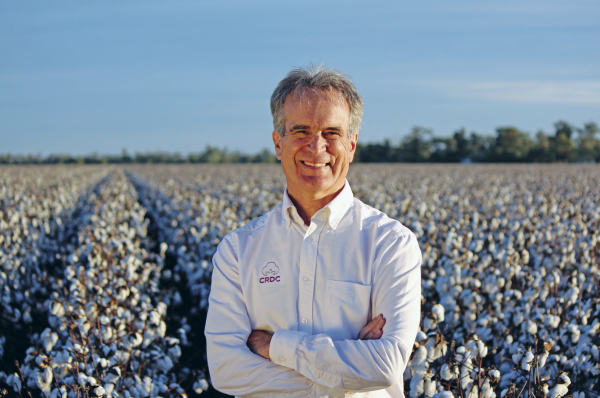
Receiving the 2026 Australian Cotton Industry Service to Industry Award was a fitting tribute to one of the industry’s champions, Allan Williams, who has been a pioneer behind the scenes and in key industry roles for 30 years.
It’s particularly pertinent given Allan has recently stepped down as Executive Director of CRDC, bringing to a close a 14-year career at the Narrabri-based organisation. The award capped a long and impactful career, spanning 30 years dedicated to agricultural science, research and development and improving the sustainability status and performance of the Australian cotton industry.

During this time Allan has lived through and actively managed industry developments and challenges, bringing his skills from time spent both on and off the farm.
As a child in the 1960s and 1970s, Allan had a front row seat to the development of a brand-new agricultural industry for Australia – cotton. His father Richard was a pioneering grower who had moved from the US to grow cotton at Wee Waa, which was by then home to a group of Americans including the Kahl and Hadley families. Indeed, it was the friendship between Frank Hadley’s mother and Allan’s grandmother that led to the opportunity for Richard to leave the family farm in Porterville, California and emigrate to Australia.
Prior to joining CRDC, Allan worked for a number of cotton industry organisations, including the Better Cotton Initiative, the Australian Cotton Growers Research Association (ACGRA) and Cotton Consultants Australia (now Crop Consultants Australia). While with ACGRA, Allan developed the industry’s Best Management Practice Program, which evolved into myBMP.
He is held in high esteem by the international cotton community, evident in his role as Chair of the International Cotton Advisory Committee’s (ICAC’s) Expert Panel on the Social, Economic and Environmental Performance of Cotton (SEEP), which he held from 2006 to 2026.
While Allan’s history with cotton is life-long, joining the cotton industry wasn’t always on the cards. After a gap-year spent working on the family cotton farm, Allan moved to Sydney to study and completed a Bachelor of Science majoring in soil science and anatomy, along with an honours law degree.
“When I left home for Sydney, I didn’t see cotton in my future,” Allan said.
“After uni I worked as a lawyer for two years, and thought my future was in the city and the profession.”
It was the sudden passing of his father Richard in 1990 that helped Allan decide to bring his family back home, to be near his mother, and this move led to his long career in cotton.
Richard’s passing not only left a hole in the family but in the industry.
“As an early supporter and promoter of research and development, Dad understood its value and importance if cotton was to become a sustainable industry for Australia.
“Dad’s lifelong passion was cotton and science, which led him to be a part of the group who formed the Australian Cotton Growers Research Association (ACGRA), which he chaired from its establishment in 1972 until his passing in 1990. He was Chair of CSD for 21 years, from 1968 to 1989,” Allan said.
“Dad believed in collaboration, vision, support and direct grower involvement in setting research priorities, which I believe are as important today as they were in 1960s.”
He was involved in the establishment of CRDC in 1989–1990 (with initial staffing of three people) and highlighted at the time the critical importance of grower feedback on R&D needs and priorities.
After coming home, it wasn’t long before opportunities to work in cotton presented. Keen to take advantage of Allan’s functional knowledge as a grower, paired with a science/law degree, in 1994, Allan was successful in gaining the role as the first Executive Officer of Cotton Consultants Australia, where he remained until 1997. He was soon approached by ACGRA to take on an Executive Officer role, where he remained until 2006.
ACGRA was the Australian cotton industry’s peak body for advising CRDC on research priorities as well as liaising with Government, so as well as supporting the identification of research priorities, key responsibilities included representing the ACGRA at industry forums, meeting with federal and state Departments of Agriculture on research-related issues for the cotton industry and drafting submissions to Government enquiries relevant to R&D.
“I guess my law experience was looked upon favourably (apart from being told at my interview to never bother wearing a suit and tie again!) given the focus on understanding R&D-related Government policy,” Allan said.
He fostered joining forces and cross-sectoral collaboration, bringing about industry membership of Plant Health Australia.
“There was definitely an element of being in the right place at the right time,” he says.
“There were plenty of challenges emerging, such as chemical supply shortages, resistance management, fibre quality and pesticide management, and Allan says he had a rapid introduction to pretty much all the key industry sectors and the issues they were facing.”
Initially the role with ACGRA involved working closely with cotton growers to review and prioritise research investments in cotton growing.
“I was intimately involved in the review of research projects and ensuring decisions were informed by conversations with growers, which seemed to work,” he says.
“Seemed to work” is perhaps an understatement, Allan was integral in turning adversity into preparedness for the industry, when Dave Anthony (ACGRA) approached him to create the Best Management Practice program (now myBMP) on the back of the pesticide crises of the early 1990s.
In 1993 a five-year research program involving CRDC, the Murray Darling Basin Commission and the Land & Water Research RDC was established. Titled ‘Minimising the impact of pesticides on the riverine environment’, the research led to the identification of options for reducing the movement off farm of pesticides. Allan codified the findings from this research into the first iteration of the BMP Manual, published in 1997, just in time to support growers to manage a new challenge when endosulfan was detected in some Australian beef exports to Japan.
“This is a great example of the strength of our evidence-based industry. A research program that was initially flagged in 1991, that led to the development of myBMP meant that in 1998 the industry was able to quickly and robustly demonstrate its ability to take responsibility and improve how pesticides were managed,” he said.
“This allowed the industry to maintain access to endosulfan as a relatively effective and certainly low-cost option and helped the industry recover reputationally.”
Bringing the research to the industry at the biennial ACGRA Australian Cotton Conference – that we have all just enjoyed again – was another of Allan’s tasks in the role.
Allan presented at this year’s conference, which marked 30 years since his first presentation introducing the BMP program. The session was titled '30 years of transgenic cotton’. He said that the success of the first transgenic variety, Ingard, was built on a long-standing commitment and active involvement by growers in investing and prioritising R&D from the early 1970s.

“The longer history is that in 1973 ACGRA instituted and collected themselves a voluntary levy of 25 cents a bale. The Association took direct responsibility for determining research priorities and distributing that levy as additional research funding,” Allan said
“It did this until 1982, when following ACGRA lobbying, the levy was raised to a $1 a bale and matched with Commonwealth funding. This saw the introduction of a formal body, the Cotton Research Committee (now CRDC), to administer the research funds, and ACGRA’s role became advisory.”
Since 1990, CRDC has been responsible for administering the grower and Commonwealth funds, with Cotton Australia as the advisory organisation following its merger with ACGRA in 2010.
“A defining strength of the Australian cotton industry is its collaborative approach to RD&E.
“Growers have always been at the centre of this system: identifying priorities, shaping investments, hosting trials, contributing data and adopting new knowledge and technologies,” he told the audience.
“Research and development are not just a scientific exercise: the success of the industry is in no small part based on the willingness of cotton growers to experiment, take risks and trial new technology. When we look back on early innovations, I can see that Australia’s cotton researchers were demonstrating systems thinking decades before ‘systems thinking’ became a buzz word.”
After 11 years working for ACGRA and on BMP Allan began a role with the global Better Cotton Initiative (BCI) as a Senior Agronomic Advisor in 2005, leading the development of a global definition for sustainable cotton production, and expanding his cotton farming perspective to locations including Brazil, West Africa, India and Pakistan.
Over the next seven years he played an integral role in defining ‘Better Cotton’, developing the Better Cotton System from scratch, which is now the world’s largest environmental standard for cotton, employing over 200 people and working with more than two million farmers. Around 20 per cent of the world’s cotton is now grown under the Better Cotton standard.
Allan’s contribution helped ensure global standards were science‑based, practical and informed by real farming systems. Australian cotton growers directly benefit from Allan’s farmer-focused approach by receiving a premium for BCI-certified cotton. An important (albeit unstated) part of the role with Better Cotton was helping educate and inform retailers and brands about the practicalities and realities of cotton farming.
“While working for Better Cotton, I also developed new relationships with unfamiliar cultures in India, Pakistan, West Africa, Brazil and Europe,” he says.
“In addition to having a close insight into cultural and geographic diversity I also managed diversity in farming perspectives, from small subsistence farmers in south Asia to large, mechanised farms in Brazil.”
It was also during this time, (then) CRDC Executive Director Bruce Finney nominated Allan for membership to the SEEP panel in 2006. SEEP was an expert panel created by the International Cotton Advisory Committee to provide advice on for the social environmental and economic performance of cotton. In his role as chair, he helped shape sustainability indicators that influence how cotton production is measured and improved worldwide.
After seven years of extensive travel for work with BCI, in 2012, Allan moved to CRDC as an R&D Manager – and a much shorter commute. He became General Manager for R&D in 2019 and Executive Director in March 2024.
Reflecting on his time in the industry during his presentation to the recent conference, Allan says while some things have dramatically changed, how cotton is removed from the plant hasn’t changed from spindles and doffers.
Similarly, he says, the importance of people in the system hasn’t changed, and applauded the increase in the number of women across the industry.
“Furthermore the culture of collaboration has been just as important to the industry's success as any individual technology or scientific breakthrough.
“Lasting progress rarely comes from a single innovation. More often, it comes from sustained investment in research, a willingness to tackle difficult problems, and growers being prepared to test, challenge and adopt new ideas.
“This is a characteristic that has long set Australian cotton apart. Australian growers are not passive recipients of research outcomes: they are active participants in shaping the direction of research itself.
“Among the many things I will take away from my time in cotton is the industry's respect for research and the willingness of growers to engage with it, few industries maintain such strong connections between those generating knowledge and those applying it.
“Whether through on-farm trials, countless conversations in paddocks and meeting rooms, CottonInfo, or the Australian Cotton Conference – which started as a pure research conference in 1982 organised by ACGRA, Australian cotton has consistently demonstrated the value of bringing researchers and growers together.
“The achievements discussed at this year's Conference are not the work of any one person or organisation. They reflect the efforts of many people over many years.
“Researchers, growers, consultants, extension specialists, industry bodies and tech providers have all contributed to building an industry that is recognised globally for its innovation, productivity, quality and willingness to embrace change.
“I am grateful for the support of many (too many to mention here) opportunities I have been given over the last 30 years, and I know I leave the industry in great shape.”